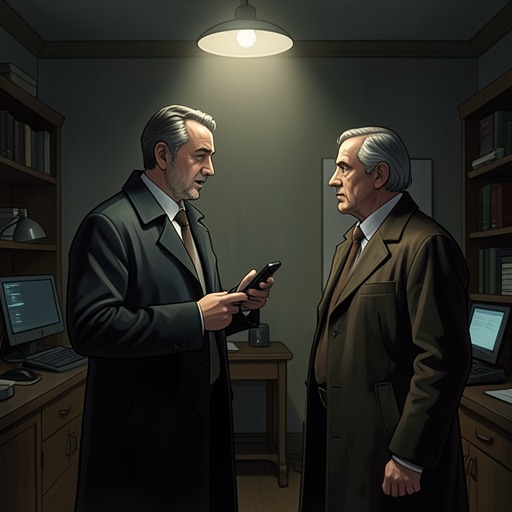
Nail-Gun Case Press Conference
The Hanging GirlThe press conference brought together senior Danish police officials, Dutch investigator Hans Rinus, reporters, and Carl Mørck. It was called to announce that murders previously treated as separate cases might share a weapon and a wider investigative history. Yet the meeting also became a public contest over attention: while the leadership focused on the nail-gun killings, Carl used the cameras to ask for help identifying a man connected to a long-dismissed death on Bornholm.
The Cases and the Weapon
Lars Bjørn introduced Carl, his head of communications, and deputy assistant commissioner Terje Ploug, who had led the investigation since Carl and his team were shot. He also introduced Hans Rinus, who had handled a similar case in a suburb of Rotterdam. Carl briefly recounted the Dutch murders: two men had been shot with a nail gun firing 90-millimeter Paslode nails, with cocaine stuffed into their mouths. Danish investigators had found no link at first, so the Schiedam case had been handed to Dutch colleagues as a local matter. Terje Ploug now called that separation a mistake.
Ploug identified the shared weapon as a PAMAS G1, a semi-automatic pistol related to the better-known Beretta 92 and produced for the French Gendarmerie Nationale. Its serial number had been filed off, and the disappearance of similar pistols from military arsenals meant its history could not be established. Ballistic examination, however, confirmed that it was the weapon used in the 2007 shooting of three police officers: Anker Høyer was murdered, Hardy Henningsen suffered permanent physical damage, and Carl was shot. Ploug placed the pistol on the table and stated that the ballistic findings linked it to those attacks; a photograph and a data sheet were then projected for the assembled press.
The Official Message and Carl’s Appeal
Lars Bjørn framed the conference as a public commitment: killings of police officers on duty would remain a high priority, and the police would continue investigating until those responsible were brought to trial. The announcement also reversed the earlier separation of cases. Investigators now believed that the nail-gun murders in Schiedam, the Netherlands, and the killings on Amager and in Sorø might be connected. Hans Rinus was invited to explain the Dutch investigation, while the Danish officials presented the newly established link as progress in a broader inquiry.
Carl Mørck used the public platform for a different purpose. Holding up a photocopy of the man beside the VW Kombi, he described a suspect in a road-death investigation: about six foot one, with blue eyes, a dimple in his chin, a husky voice, strong features, dark eyebrows, and wide front teeth bearing a small light mark. The man spoke fluent Danish, was known as Frank Brennan, and had since adopted a more unusual name. Carl identified the vehicle as a light-blue VW Kombi with a broad fender; its large peace sign, painted on the roof, was not visible in the photograph.
The appeal tied Frank Brennan to Bornholm in 1997, where he had taken part in excavations of timber circles—platforms supported by thick posts and used for sun worship and offerings of stone and animal bone. Carl said the investigators knew that Frank Brennan worshipped the sun and thought he might still do so. Lars Bjørn tried to halt the disclosure, insisting that the case should be withheld until the police had more to go on. Carl continued, directing anyone with information to contact Department Q and pointing to the number beneath the photograph. By putting the image directly before the television camera, he turned a conference intended to update the public on linked nail-gun killings into an appeal for information about the man he believed could resolve the Alberte case.
The Unsettled Basis of the Appeal
The conference took place against an investigation whose earlier assumptions had never been securely tested. The papers Superintendent Birkedal had handed over were not updated after 2002, and the possibility that Alberte Goldschmid had been deliberately killed had not been considered. The book leaves open why: perhaps officials feared that a murder case could not be shelved, perhaps the impact site had not been analyzed adequately, or perhaps Christian Habersaat’s forceful insistence on his own theories had discouraged other investigators from challenging him. Because the case had not gone to the mobile task force, no one had introduced sufficient doubt into the local team’s initial view of the death.
That uncertainty shaped the technical work Carl was pursuing alongside the public appeal. He asked that Christian Habersaat’s drawings be scanned and checked against archived analysis of the wooden board, including whether it could have survived a collision, been fastened to the pictured vehicle without leaving marks, and contributed to Alberte Goldschmid being thrown toward and breaking its windshield. He also wanted technicians to improve the photograph of the man with the VW Kombi, while the team continued trying to locate its photographer or the negative. These were questions for testing a theory, not proof that the board or the pictured man had caused the death. The conference’s appeal thus exposed both the urgency of finding the man and the uncertainty still separating a compelling reconstruction from an established account.
Later Evidence and Reassessment
The public appeal for Frank Brennan belonged to an investigation that would eventually have to dismantle its own most persuasive leads. A later photograph showed Bjarke Habersaat, grinning in his Boy Scout uniform beside a four-wheel drive fitted with a plow. Carl recognized that the team’s laborious search for a wooden board had grown from a small splinter Christian Habersaat had found, while its pursuit of the VW Kombi and suspicion of Frank Brennan, later known as Atu Abanshamash Dumuzi, had also led them away from the truth. The photograph redirected attention from the man displayed at the conference toward Bjarke and the vehicle in the image.
Rose then questioned whether Christian Habersaat could really have been unaware that his son had a plow, and proposed that he had pursued the case so insistently because he suspected Bjarke but wanted suspicion to fall on the man he hated: his wife’s lover. When the investigators confronted June Habersaat with the theory that Bjarke had killed Alberte Goldschmid out of jealousy, June claimed that she herself was responsible. Christian Habersaat’s letter ultimately supplied a different account: after finding Bjarke’s poem, he understood that his son loved the same man as June and had killed Alberte after being displaced by her. He admitted that he had persistently tried to implicate an innocent man and left the matter to the investigators because he could not bring himself to pursue his own son. The conference’s image-led appeal therefore stands in sharp contrast with the later correction: a confident public search for Frank had amplified a theory that the evidence would overturn.